KIT XRF-FB Kiln Feed-Clinker-Clinker Oil Well
METHODS OF CONTROL AND CALIBRATION XRF with Fuse Bead
The SNL is currently developing different calibration kits for your XRF & XRD with three sets of kits
- « KIT XRF-FB » enabling to calibrate your XRF on several componants with a large range of measures . 3 versions are available
- SNL-XRF-FB1 for the analysis of CEM I and CEM II/A cements
- SNL-XRF-FB CEM II+ for cement analysis with more than 10% additions.
- SNL-XRF-FB 3 for the analysis of raw mix and clinker
- « KIT XRF-componant » allowing to analyse the same componant on a broad range of measures
- Chlorine
- SO3 and Alkalis
- P205
Technical Specifications
The XRF Fused Beads Reference Materials “Kit 3: kiln feed, clinker and CEM I” consist of 10 homogenized and stable samples that have been rigorously validated through international interlaboratory testing. These samples serve as essential reference materials to ensure and maintain the accuracy of X-ray Fluorescence (XRF) calibrations during routine laboratory operations. They enable continuous monitoring and detection of calibration drift using recommended control charts.
The SNL XRF Kit 3 complements the SNL XRF Kits 1 and 2, which are specifically designed for the calibration and validation of XRF fused-bead analyses of cement: Kit 1 covers CEM I and CEM II/A cements containing less than 10% additional constituents, and Kit 2 covers CEM II/B to CEM V (excluding CEM III).
- SNL XRF Kit 3 focuses on the characterization of kiln feed, clinker, and CEM I. It extends the calibration range to cover the growing diversity of materials while maintaining high analytical accuracy and robustness.
- Together with the forthcoming SNL XRF Kit 4 (planned for Q1 2027), these reference materials provide a complete and comprehensive portfolio of XRF fused-bead reference materials for the cement industry, covering the entire production process from raw materials to finished cement and supporting the characterization of both conventional and emerging low-carbon cementitious materials.
Note: SNL XRF Fused Bead Reference Materials are not suitable for use with XRF pressed pellet methods — using them in this context can result in inaccurate calibrations and control values due to significant matrix effect differences, ultimately compromising the reliability of analytical results. It is essential to understand that the mineralogy of each produced and purchased material is highly specific. The fused bead method is the only approach that effectively eliminates mineralogical and matrix-related variability, ensuring accurate and consistent XRF calibration. Please refer to the requirements specified by your XRF equipment suppliers for further guidance.
Each of the inter-laboratory campaigns involves more than 150 international cement laboratories, as well as XRF suppliers and some accredited laboratories. The logic of the ISO 5725-2: 2019 “Accuracy (trueness and precision) of measurement methods and results Part 2: Basic method for the determination of repeatability and reproducibility of a standard measurement method” is applied at each step of the elaboration process (excluding Grubbs and Cochran tests, replaced by the “interquartile method”).
2- SNL XRF Fused Bead Reference Samples Characteristics
The properties of the ten SNL XRF Fused Bead Reference Cement Samples represent the most accurate estimates of their true values. These reference values are derived from the statistical evaluation of results obtained by all participants in the Round Robin Tests, with outliers excluded according to robust statistical methods. Each value is accompanied by an estimate of measurement uncertainty, including both the combined standard uncertainty and the expanded uncertainty (typically at a 95% confidence level).
For chemical analysis, it is important to note that the majority of participating laboratories calibrate their instruments using Certified Reference Materials (CRMs) with metrologically traceable certified values. Consequently, the assigned values of the SNL XRF Fused Bead Reference Samples inherit a level of traceability to the International System of Units (SI) through an unbroken metrological chain.
The SNL XRF Fused Bead Reference Samples are developed by the principles and guidelines outlined in ISO Guide 35: Reference Materials — Guidance for Characterization and Assessment of Homogeneity and Stability. Comprehensive characterization has been performed using robust analytical methods across multiple international laboratories. Statistical assessments confirm the homogeneity and long-term stability of the samples. The assigned reference values are accompanied by combined and expanded uncertainties, estimated in full compliance with the Guide’s requirements. This rigorous approach ensures that the SNL XRF Fused Bead materials are fit for use as reliable and metrologically traceable reference standards in cement chemical analysis and XRF calibration.
Kit 3 consists of 10 fused-bead reference materials, XRF-FB-15 through XRF-FB-24, covering the compositional range typical of raw meal, kiln feed, and clinker matrices.
We recommend supplementing this set with 3 additional materials from Kit 2 — XRF-FB-11, XRF-FB-12, and XRF-FB-14 — to extend the concentration range for each analyzed oxide (e.g., CaO, SiO₂, Al₂O₃, Fe₂O₃, MgO, SO₃, K₂O, Na₂O). Broadening the calibration range in this way improves coverage of low- and high-concentration endpoints, reduces extrapolation error, and strengthens the linearity of the regression across the full working range. The objective is to achieve a finer, more robust calibration curve with improved analytical accuracy and precision for routine XRF fused-bead analysis of cement raw materials and clinker.
This is a recommendation and should be evaluated against the specific calibration validation criteria (e.g., correlation coefficient, standard error of calibration, RMSEP) applicable to the laboratory’s quality system.
As received basis:

Ignited basis:

From As-Received to Ignited Basis
Oxide compositions are commonly reported “as received,” meaning the percentages include Loss on Ignition (LOI) — the mass lost during heating (typically ~950–1000°C) due to the release of volatile components such as CO2, H2O, and other combustibles. To compare materials on a common, volatile-free basis, results are converted to an “ignited basis,” which expresses each oxide as a percentage of the LOI-free (ignited) mass.
The conversion is:
- Ignited value (%) = As-received value (%) / (1 − LOI_as-received / 100)
This rescales every oxide upward by the same factor, since removing the LOI mass concentrates the remaining oxides. LOI itself becomes 0% by definition on the ignited basis, and the sum of all other oxides should total close to 100%.
Packaging
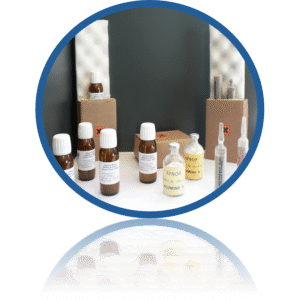
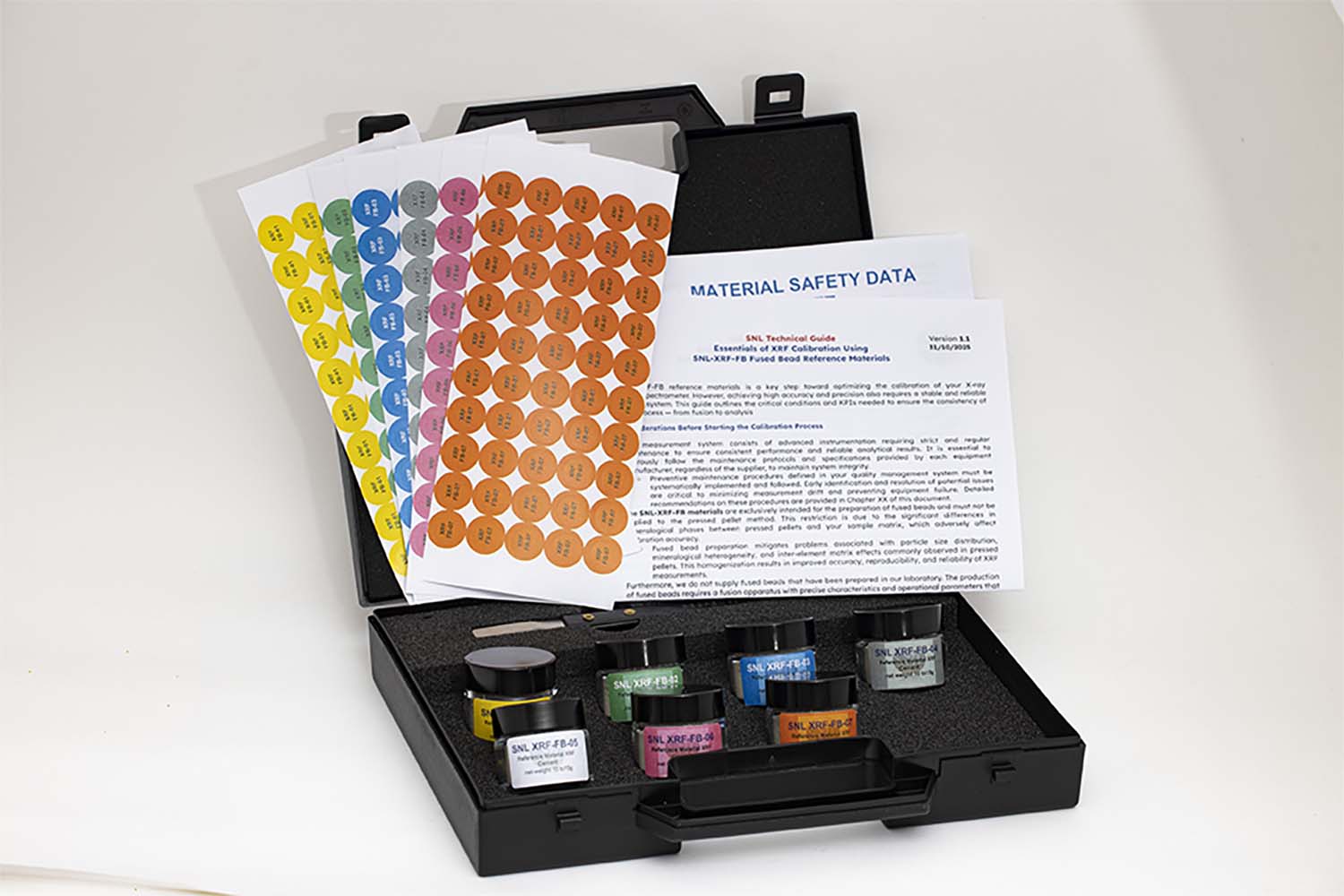
The KIT consists of a case of 10 samples in hermetically sealed glass containers of about 10 grams and a spatula. The “calibration best practices manual” is provided with the certificates when ordering. This manual is the exclusive property of SNL and may not be communicated to a third party or purchased separately from the SNL-XRF-FB KIT.
Additional information
| Type | Reference Material |
|---|---|
| Type of Control | Chemical ( XRF – Fuse bead) |
| Type of Material | |
| Detail of Material | |
| Conditionnement |